Twin Rocks Turnaround Park
Twin Rocks Turnaround Park: Rockaway Beach's Quiet, Hidden Sanctuary
Twin Rocks Turnaround Park is the kind of place you have to be looking for: a small, hushed sanctuary hiding in plain sight along Rockaway Beach's busy shoreline.
On a summer afternoon, Rockaway Beach hums with the sounds of kettle corn vendors, kites snapping in the wind, and the thud of boogie boards hitting the surf.
Tourists crowd the sand near the Rockaway Beach Wayside, off Hwy 101, cameras raised, kids racing toward the waves.
But drive just a few blocks south, past the last cluster of beach cottages, and the noise fades into something else entirely: the hush of wind moving through a stand of shore pines at Twin Rocks Turnaround Park, a place most visitors drive right past without ever noticing.
Introduction
Rockaway Beach stretches for seven unbroken miles along the Oregon Coast, one of the longest sandy shorelines in the state.
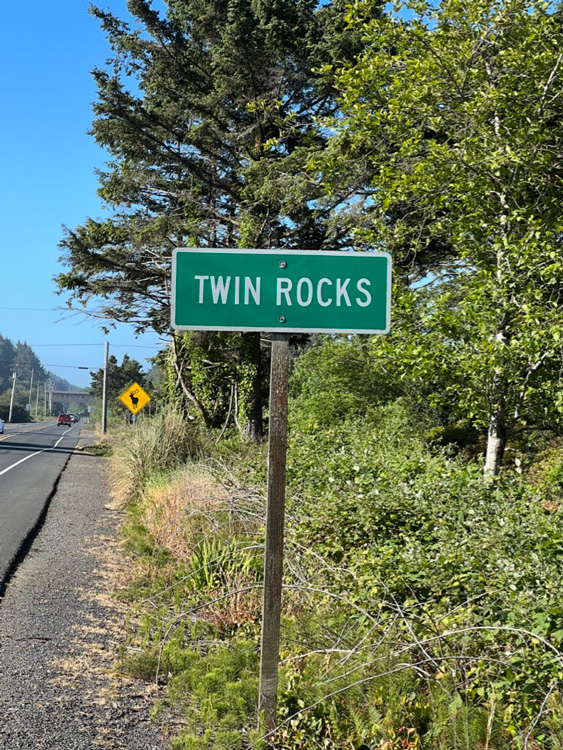
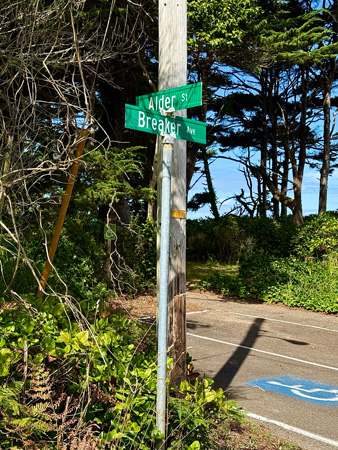
Amid its many access points sits a lesser-known gem: Twin Rocks Turnaround Park, tucked at 905 S. Breaker Ave.
It rarely appears clearly marked on maps, which is part of why it remains so peaceful.
This article explores the park's history, its accessibility features, the deep geological story behind the offshore rock formation it overlooks, and practical tips for visiting.
Key Takeaways
- Hidden but accessible. Twin Rocks Turnaround Park is easy to overlook on a map, yet it offers one of the few fully ADA-accessible paved trails to a beach view on this stretch of coast — a rare example of wheelchair accessible beach trail design along the Oregon Coast.
- Built from a personal legacy. The park sits on land donated by the family of Edith Hart, Twin Rocks' original postmistress, specifically so it could serve disabled visitors.
- A geological showpiece. The offshore Twin Rocks formation dates back 18 to 15 million years and shares its volcanic origin with the hot spot that later formed Yellowstone.
- A quieter alternative. Unlike busier access points such as Minnehaha Street, this park offers benches, picnic tables, and solitude away from Rockaway Beach's main tourist bustle.
"There's a real psychological relief in finding a natural space without the weight of other people's presence — the nervous system settles in a way it simply can't amid crowds. A quiet park like this doesn't just offer scenery; it offers room to actually hear your own thoughts again."
~ Joannie Welch, Counselor, Seaside OR
How To Find It
Twin Rocks Turnaround Park sits at 905 S. Breaker Ave., Rockaway Beach, OR 97136, just north of W. Washington Street near S. 9th Ave.
It's the kind of place locals know by heart and visitors stumble upon by accident.
Parking is simple: four paved, clearly marked spaces sit across from the park, along with two handicapped spots directly in front, making this one of the more thoughtfully designed accessible beach parks Oregon has to offer.
For those exploring the broader network of Rockaway Beach attractions, nearby alternate access points at Minnehaha Street and W. Washington Street round out the options for reaching the sand.
The History Behind Twin Rocks Turnaround Park
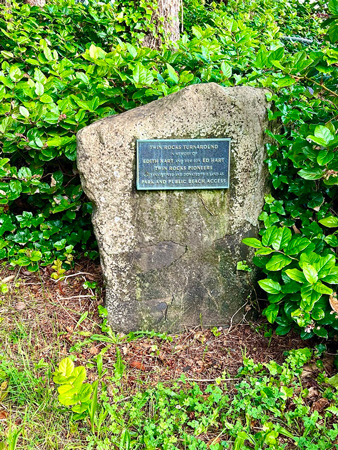
The land beneath Twin Rocks Turnaround Park was once the homesite of Edith Hart, the original postmistress of the nearby Twin Rocks community, and her son Ed — both now deceased.
This chapter of Edith Hart postmistress history is woven into the region's broader story: the Twin Rocks post office was established in 1914, with William E. Dunsmoor serving as its first postmaster, before it closed in 1954.
The Hart family eventually deeded their land to Tillamook County specifically so it could become a public park — one of the more quietly meaningful Tillamook County parks along this coastline.
"Ed wanted handicapped accessibility," recalled park advocate Barbara Trout, who also credited her friend Dorothy Diel with stopping an earlier county plan that would have sold the land off entirely.
Ed Hart, it turns out, once dreamed bigger. He imagined a tour-bus destination modeled on the Seaside Promenade, and even floated the idea of a viewing tower overlooking Twin Rocks itself.
Those grander visions never came to pass, but the park's quiet grandeur stands on its own, needing no tower to feel worthy of a visit.
As Trout put it, reflecting on Edith Hart's early arrival and the prime ocean view she secured for the family: "If you're the first one there, you get to pick the view you want."
What Visitors Will Find Today
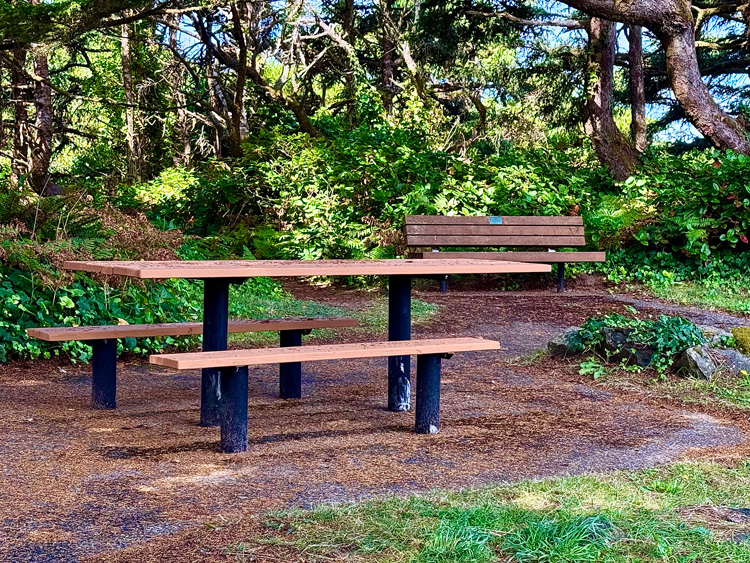
A stand of mature trees and native roses shades the park, giving it the feel of a wooded hideaway tucked just steps from the ocean.
Two ADA-compliant parking spaces connect to a paved, handicap-accessible asphalt trail leading down toward the beach — genuine ADA accessible beach access Oregon travelers with mobility needs rarely find elsewhere on this stretch of coast.
Two picnic tables are specifically designed for disabled patrons, and four benches total are positioned to take in both the surrounding greenery and the ocean beyond.
At trail's end, a matched pair of benches bearing memorial plaques looks out over the beach — a fitting, contemplative spot to sit in silence.
One practical note for visitors: the paved trail ends with a sharp three-foot drop to the sand, worth knowing before you go.
Compared to busier access points nearby, Twin Rocks Turnaround Park offers a level of accessible infrastructure that's genuinely uncommon among quiet beach parks Oregon Coast travelers might stumble across.
Getting To The Beach
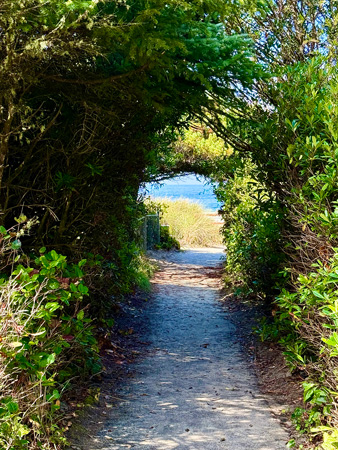
At the east end of Twin Rocks Turnaround Park, visitors reach the beach through two distinct pathways branching from the park entrance, each offering a different way to experience this hidden gem in Rockaway Beach.
The main route, on the left, is a fully paved trail, purpose-built for wheelchair accessible beach trail access, making it easy for wheelchairs, baby strollers, and anyone who prefers solid, level footing to move comfortably from the parking area toward the shoreline.
This paved path reflects the original intent behind the park's creation, since Ed Hart specifically wanted the space to serve visitors with mobility needs when the land was donated to the county.
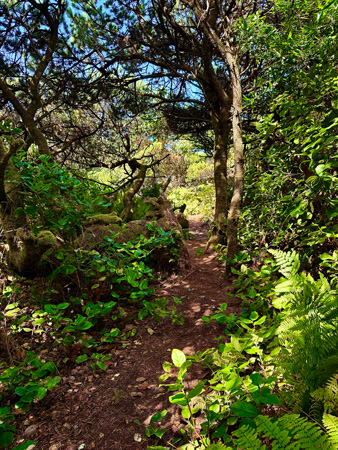
To the right, a second, narrower trail winds through the park's natural surroundings, threading past mature trees and native roses before opening onto the sand.
This unpaved option feels more like a nature walk than a formal path, giving visitors who don't need accessible infrastructure a quieter, more immersive way to reach the beach.
Together, the two routes make this one of the more thoughtfully designed accessible beach parks Oregon has to offer along this stretch of coastline, and a genuine Rockaway Beach hidden gem for locals and travelers alike.
Morning Light Through the Pines
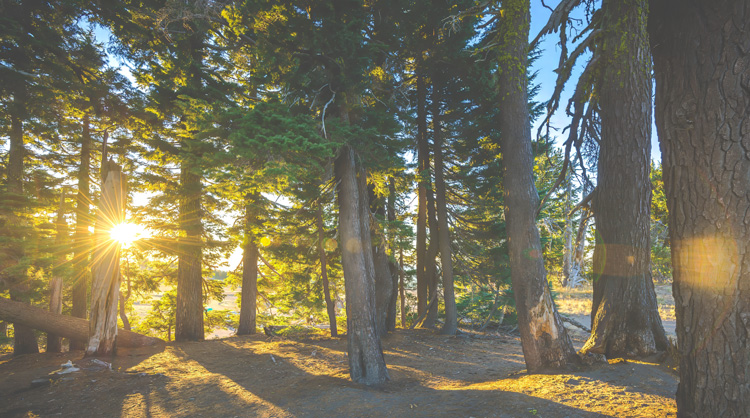
Arrive at Twin Rocks Turnaround Park early enough, and you'll catch a quieter kind of scenery than the ocean view it's known for.
Tall pines and a stand of mature trees shade much of the park's interior, and in the early morning hours, sunlight breaks through the canopy in soft, shifting shafts that fall across the paved path and picnic tables below.
The light filters unevenly through the branches, casting a dappled pattern over the native roses and undergrowth that line the trail, giving the whole space a hushed, almost secluded feel before the day's beachgoers arrive.
It's a fitting quiet prelude to the park's main attraction. Walking beneath that gold-tinted canopy toward the sound of waves builds a natural sense of anticipation, transitioning from forest stillness to open coastal views of Twin Rocks just beyond the tree line.
For photographers or early risers, this brief window of morning light through the pines is one of the park's most underrated, peaceful moments.
Ellen Mertz (57) a retired teacher from Enid OK said, "This is such a beautiful place. I run two miles everyday. I drive to the parking lot and strretch out by the picnic table. I run a mile, then come back and do 10 push-ups against the picnic table. Then I run the last mile and come back, do 10 more push-ups, and cool down with some hot herbal tea. I love the streaming sunlight."
A Restorative Vibe

There's something quietly restorative about sitting on a bench at Twin Rocks Turnaround Park, away from noise and obligation, with nothing to do but simply be present.
Psychologists have long pointed to the calming effect of natural settings on the nervous system — the way birdsong, ocean rhythm, and dappled light can lower stress and ease a racing mind. But this small park offers something beyond relaxation.
offers space for reflection: a place to pause, breathe, and take stock of what you're grateful for.
Facing the ocean and the ancient rock formation beyond it, many visitors find themselves settling into a kind of meditation without even trying — thoughts slowing, worries softening, perspective widening.
There's a spiritual quality to sitting quietly before something so much older and larger than yourself. In that stillness, gratitude tends to surface naturally, and the mind finds its way back to what truly matters.
The Star of the View: Twin Rocks Itself
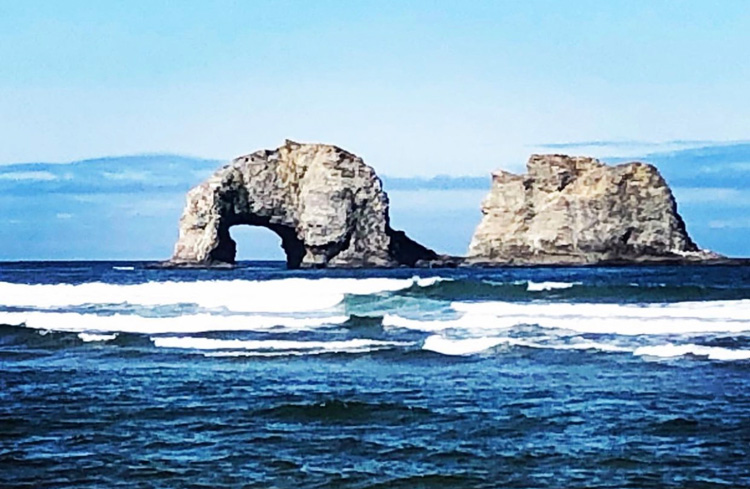
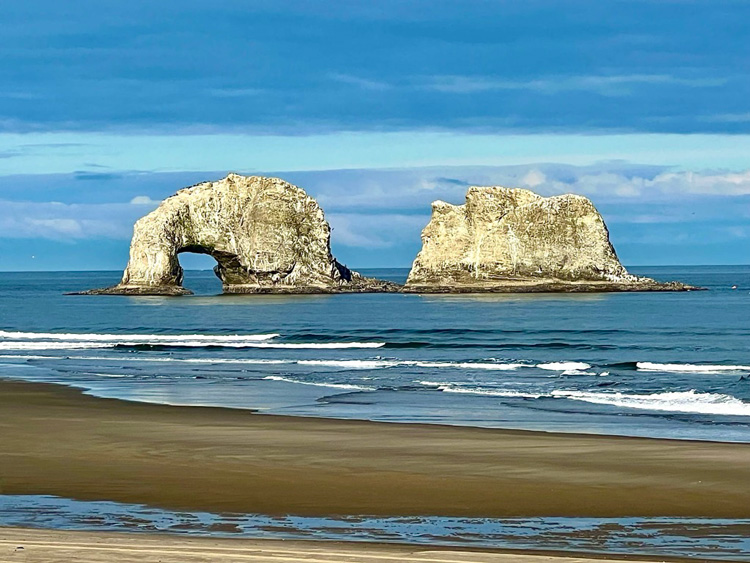
The offshore formation that gives Twin Rocks Rockaway Beach its name was originally called "Profile Rocks." It was renamed Twin Rocks in 1925 to avoid confusion with another Profile Rocks Oregon formation located elsewhere in the region.
Geologically, Twin Rocks is technically an "intrusive" — lava that traveled underground before re-erupting elsewhere, connected to the same massive volcanic hot spot that eventually formed Yellowstone National Park roughly 18 to 15 million years ago.
This is one of the more striking Oregon Coast volcanic rock formations, and its deeper Twin Rocks geology history is a story of patience: at the time of formation, the Oregon coastline sat 75 to 100 miles farther inland than it does today.
Erosion over an estimated 45 million years slowly chiseled what was once a single connected mass into its current two-part form.
Oregon geologist Ernst Lund offered a memorable, simple description: "One is an arch, the other a stack." The arch's hole measures roughly 35 feet across, and the pinnacle rises about 88 feet high.
Twin Rocks also bends the sea itself. The formation redirects and slows incoming waves, which then deposit extra sand in front of it — occasionally creating a visible land bridge at low tide connecting the rocks to the beach.
For the closest dry-land view, Minnehaha Street beach access sits under half a mile away. But for a quieter, more contemplative angle aimed directly at the formation, Twin Rocks Turnaround Park remains unmatched among Oregon Coast scenic viewpoints.
Conclusion: Why It's Worth the Detour
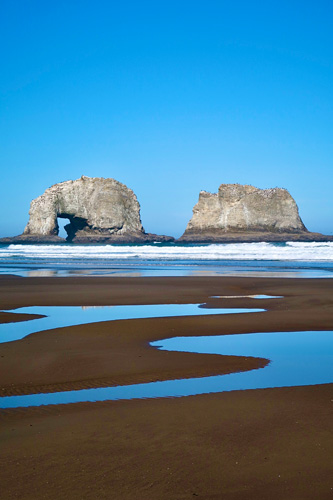
What makes Twin Rocks Turnaround Park special isn't grandeur — it's stillness.
Solitude, accessibility, history, and a front-row seat to a geological landmark tied to ancient volcanic origins all meet in one small, unassuming spot.
There's a quiet spiritual resonance to sitting on those memorial benches, watching waves bend around rock that formed millions of years before anyone stood there to watch it.
If you're compiling a list of things to do in Rockaway Beach, pair a visit here with the Red Caboose at the Chamber of Commerce park and a ride on the Oregon Coast Scenic Railroad for a fuller day trip — then save Twin Rocks Turnaround Park for the quiet close to your afternoon.
As Barbara Trout said of Edith Hart's foresight in claiming this spot generations ago: "If you're the first one there, you get to pick the view you want."
Today, thanks to her family's gift, everyone gets to share it.
#twinrocksturnaround #rockawaybeach #oregoncoast #accessibletravel #oregonhiddengems